How to Import Wooden Toys What Distributors Need to Know?

Time:2026-10-21 Author:Charlotte
0%

Importing wooden toys can look simple: choose a design, place an order, and arrange shipping. In practice, each step affects safety, cost, and customer trust. Distributors must evaluate the wood, coatings, adhesives, packaging, and manufacturing process before approving a supplier. A smooth sample does not guarantee consistent production.

So, what should distributors know before importing wooden toys? They should confirm the toy’s intended age range, dimensions, small-part risks, surface finishes, and durability. Ask for current test reports from qualified laboratories, not only attractive product photos. Review material specifications, batch controls, labeling, warnings, and traceability records. Requirements vary between markets, so distributors should verify applicable rules with competent local authorities and experienced compliance professionals.

Supplier experience matters. Request factory details, production photos, sample records, and references from established buyers. Check whether the supplier can maintain color, shape, moisture levels, and packaging quality across large orders. A wooden puzzle may arrive with rough edges, loose pieces, or unexpected odor if inspections are rushed. These details can create returns and damage a carefully built brand.

Costs also deserve realistic planning. Include sampling, testing, inspection, freight, customs procedures, storage, insurance, and possible product adjustments. Some distributors focus too heavily on the factory price. That is a mistake worth reconsidering. A reliable import plan balances design appeal, verified safety, predictable quality, and responsible sourcing. This guide explains the practical decisions distributors need before bringing wooden toys into their target markets.
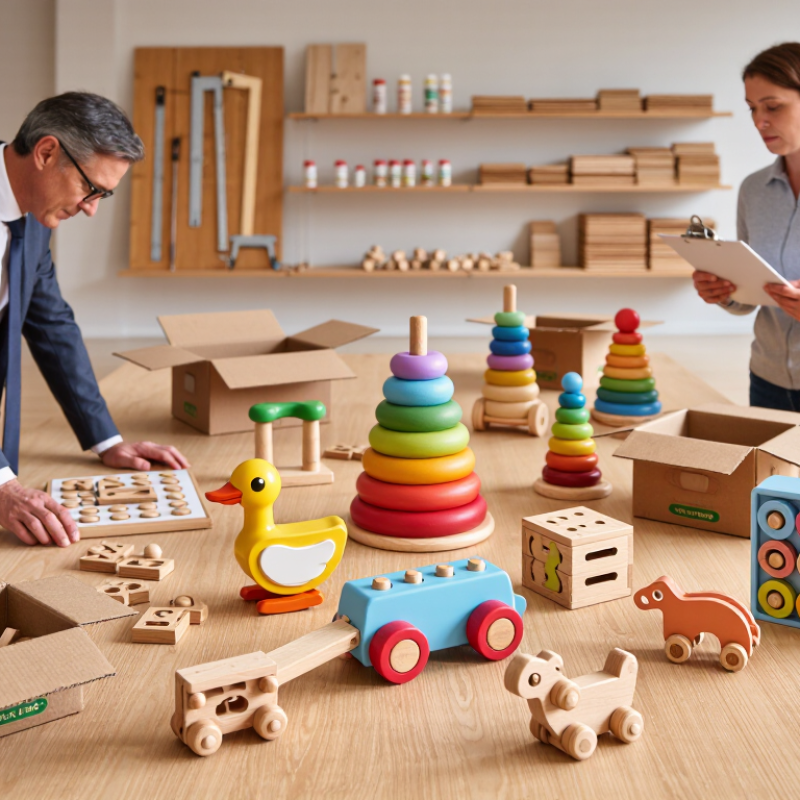
How to Import Wooden Toys What Distributors Need to Know?

Understanding Wooden Toy Import Requirements and Product Categories

Wooden toys are not one import category.

Distributors should separate puzzles, stacking toys, pull-along products, pretend-play sets, and early-learning manipulatives. Each category can involve different age grading, small-parts risks, and testing evidence.

A 2024 Grand View Research report estimated the global educational-toy market at about USD 62 billion in 2023. That figure suggests demand, but it does not prove every wooden product will sell.

Import requirements depend on the destination market.

In the United States, children’s toys generally require testing against ASTM F963, lead and phthalate limits, tracking labels, and a Children’s Product Certificate.

The U.S. Consumer Product Safety Commission reported about 231,700 toy-related emergency-department injuries in 2023.

Smooth sanding is not enough. Inspect paint, magnets, cords, hinges, and detachable wheels. One hidden risk remains.

For European distribution, products normally need conformity with the Toy Safety Directive, relevant EN 71 standards, chemical restrictions, technical documentation, and appropriate labeling.

Confirm the correct age group before ordering. A three-piece puzzle for toddlers is not equivalent to a complex model kit.

Ask suppliers for material declarations, test reports, batch records, and packaging measurements. Check whether documents match the exact product, not a similar sample.

This step is often rushed. It should not be. Product categories, customs descriptions, and safety files must tell the same story.

Checking Safety Standards, Materials, and Age-Grade Regulations

Importing wooden toys requires more than checking whether the surface looks smooth. Distributors should verify the applicable safety standard before placing an order. In the United States, children’s toys generally follow ASTM F963 and CPSIA requirements. In Europe, EN 71 testing and the Toy Safety Directive are central references. The CPSC’s Toy-Related Deaths and Injuries report estimated 231,000 toy-related emergency department injuries among children under 15 in 2023. Small parts, falls, and sharp edges remain practical concerns.

Material checks need equal attention. Ask for laboratory reports covering lead, restricted phthalates, heavy metals, coatings, and mechanical hazards. Wood should be dry, stable, and free from splinters. Paint must resist peeling after repeated handling. Adhesives also deserve review. A natural-looking finish is not automatically safer. It can still contain restricted substances. Check batch numbers, supplier declarations, and test dates. A certificate is not proof forever.

Age-grade rules affect design, packaging, and sales channels. A toy for children under three must receive stricter small-part assessment. CPSC’s Age Determination Guidelines connect toy features with children’s abilities and likely behavior. Review choking risks, cord length, removable wheels, and breakable accessories. Inspect production samples, not only photographs. Some checks will still fail. That is useful evidence, not embarrassment. Keep corrective-action records and repeat testing after material or factory changes. Too many importers trust one old report, and that shortcut can become expensive.

How to Import Wooden Toys: Safety Standards, Materials, and Age-Grade Regulations

EU EN 71-3 lead migration limits differ by the physical form of the toy material. Wooden toys may include coatings, paints, adhesives, or scraped-off surface materials, so distributors should identify the correct material category before testing.

How to read this chart: The figures show maximum lead migration limits under EN 71-3, expressed in mg/kg of migrated material. They are not total lead-content limits. Age grading, intended use, accessible parts, surface coatings, and national import rules must also be checked separately. Always verify the current version of the applicable standard before placing a product on the market.

Reference: EN 71-3 migration limits for Category I, II, and III toy materials.

Selecting Reliable Suppliers and Verifying Product Documentation

Importing wooden toys requires more than finding an attractive product at a low price. Reliable suppliers should explain their wood sources, production controls, and quality checks clearly. Ask for a complete company profile, factory address, production photos, and recent shipment references. A supplier who avoids specific answers may create problems later.

Review every document against the actual toy. Check the material declaration, paint and coating information, test reports, age grading, packaging details, and batch numbers. The laboratory’s name, test date, sample description, and report number should be visible. A clean-looking certificate can still hide gaps. Confirm that the tested sample matches the final design, including paint color, magnets, wheels, and small parts. Requirements can differ between destination markets, so use current official guidance and qualified compliance professionals. I have seen sourcing teams trust an old report too quickly.

Tips: Request a pre-shipment sample and compare it with the approved sample. Keep invoices, inspection photos, test reports, and supplier messages in one file. Ask how defects are recorded and corrected. Do not rely only on factory promises. A second inspection may seem costly, but one loose part can damage customer trust. Suppliers should also explain recall procedures, although many buyers forget to ask.

How to Import Wooden Toys: What Distributors Need to Know — Selecting Reliable Suppliers and Verifying Product Documentation

Verification Dimension What the Distributor Should Request Key Facts to Verify Recommended Verification Method Priority
Supplier Legal Identity Business registration, manufacturing address, export authorization, and authorized signatory details The legal entity on the quotation, invoice, test reports, packing list, and shipping documents should be consistent. Cross-check registration records, factory address, domain email, bank-account beneficiary, and purchase-contract information. Critical
Product Specification Final product specification, drawings, bill of materials, age grading, dimensions, weight, and packaging artwork The tested sample must match the production version in wood type, coatings, adhesives, magnets, fasteners, and packaging. Assign a unique product code and approve a sealed “golden sample” before mass production. Critical
Toy Safety Testing Complete test report from a competent laboratory, including the exact model number and sample description Common frameworks include EN 71 for the European market, ASTM F963 for the United States, and ISO 8124 for international toy-safety testing. Confirm the applicable destination-market standard, report scope, test date, laboratory accreditation, and product photographs. Critical
Chemical Compliance Material declarations and laboratory results for coatings, pigments, adhesives, plastics, and treated wood For U.S. sales, children’s products are subject to applicable lead limits under the Consumer Product Safety Improvement Act; accessible component lead is generally limited to 100 ppm. Phthalate restrictions can apply to certain children’s toys. Review test methods, detection limits, component breakdown, and whether the report covers every accessible material. Critical
Mechanical and Physical Safety Mechanical test records covering small parts, sharp points, sharp edges, torque, tension, impact, and drop performance Wooden toys can create hazards through splinters, loose components, detachable wheels, cords, magnets, or poorly secured hardware. Use production samples for independent testing and perform incoming inspections for cracks, burrs, loose parts, and coating damage. Critical
Age Grading and Warnings Age-grade rationale, hazard assessment, use instructions, warnings, and language-specific labels Age grading should reflect the product’s design, foreseeable use, small-part risk, and destination-market requirements. Compare the warning text and symbols with the approved safety assessment and local labeling rules. High
Declaration of Conformity Applicable conformity declaration signed by the responsible manufacturer or importer For products placed on the European market, the declaration should identify the product, applicable legislation, standards used, responsible entity, and signature. Check that the declaration matches the current model, destination market, test reports, and production revision. High
Traceability and Marking Batch or lot code, production date, manufacturer or importer details, country of origin, and product identification Traceability information should allow the affected production batch to be identified during a complaint, withdrawal, or recall. Verify that markings are durable, legible, and consistent across the product, packaging, carton labels, and shipping records. High
Wood Material and Treatment Wood species or material description, moisture information where relevant, coating details, and treatment declaration The declared material should match the actual product. Any preservative, fumigation, or chemical treatment must be disclosed and checked against destination requirements. Review bills of materials, coating safety data, supplier declarations, and physical samples from each approved production source. High
Packaging and Shipping Documents Commercial invoice, packing list, bill of lading or air waybill, purchase order, and customs classification information Product descriptions, quantities, carton counts, gross weight, net weight, consignee details, and tariff classification should agree across documents. Conduct a pre-shipment document review and reconcile the final packing list with the inspection report. Medium
Factory Quality System Quality-control procedures, inspection checklist, defect classification, calibration records, and corrective-action process A reliable supplier should control incoming materials, production changes, assembly, finishing, final inspection, and batch traceability. Request a remote or on-site audit and verify that documented procedures are used in actual production. High
Pre-Shipment Inspection Inspection report with sample size, acceptance criteria, defect photographs, measurements, carton checks, and result status Inspection results are only meaningful when the inspected goods represent the final production batch and approved specification. Use a documented sampling plan, record nonconformities, and release shipment only after corrective actions are verified. High
Change-Control and Recall Readiness Written notification procedure for changes to materials, coatings, tooling, factory location, subcontractors, or packaging A new material or manufacturing change can invalidate previous testing or create a new safety risk. Include change approval, retesting triggers, batch records, customer complaint handling, and a documented recall process in the supply agreement. High
Note: Import requirements vary by destination country, product design, age grading, materials, and sales channel. Confirm the current rules with the relevant customs authority, toy-safety regulator, and qualified compliance professional before shipment.

Managing Customs, Shipping, Duties, and Import Clearance

How to Import Wooden Toys: What Distributors Need to Know

Importing wooden toys involves more than booking a container. Customs officers need accurate product descriptions, tariff classifications, invoices, packing lists, and transport documents. A vague description such as “children’s items” can delay clearance. Describe the toy, materials, quantity, value, and intended use clearly.

Check the destination’s safety rules before shipment. Wooden parts may require proof of treatment, especially when pests or untreated timber are concerns. Paints, coatings, adhesives, and small components can also trigger testing requirements. Ask suppliers for material declarations and recent inspection records. Documents should match the physical goods. Small differences create large delays.

Shipping terms must be understood by everyone involved. Confirm who pays freight, insurance, port charges, duties, and local taxes. Calculate the landed cost before placing an order. Customs value may include more than the factory price, depending on local rules. A licensed customs broker can review classification and prepare import clearance, but the distributor remains responsible for correct information. Do not assume the broker will catch every error. A spreadsheet can still be wrong. Recheck carton counts, weights, and serial references before dispatch. Port congestion, inspections, and missing certificates may add storage fees. Build time into the schedule. That part is often underestimated.

Building a Compliance and Quality Control Process for Distribution

Importing wooden toys requires more than checking cartons and invoices. Distributors need a documented compliance and quality control process from supplier selection to warehouse release. The U.S. Consumer Product Safety Commission’s 2023 Toy-Related Deaths and Injuries report estimated 231,000 emergency department-treated toy injuries among children under 15. That figure makes traceability essential. Keep supplier declarations, material specifications, test reports, and production photographs for every batch. Check wood moisture, surface splinters, joint strength, small parts, and paint or coating safety. Use recognized requirements, such as ASTM F963 or EN 71, according to the destination market.

A strong process uses risk-based sampling, not visual inspection alone. Test high-risk components more frequently, especially painted surfaces, magnets, wheels, and detachable parts. Verify that laboratory reports match the exact product, factory, and production date. The European Commission’s Safety Gate reports regularly identify toys among the most frequently notified product categories, showing why paperwork alone is insufficient. A useful weakness to acknowledge: sampling can miss isolated defects. Review complaints, returns, and near-misses monthly, then adjust the inspection rate. No process is perfect.

Tips: Photograph sealed cartons before shipment. Assign one batch code to each purchase order. Keep a retained sample in dry storage. Ask suppliers to notify you before changing wood, paint, glue, packaging, or subcontractors. Recheck labels after artwork revisions. A simple spreadsheet can work, but only if someone owns the updates.

FAQS

Which safety requirements should distributors check before importing wooden toys?

Check the current toy safety requirements in the destination market. Review mechanical hazards, coatings, small parts, and age-grade rules. Requirements can change.

What material checks are important for wooden toys?

Confirm that wood is dry, stable, and free from splinters. Test paint, coatings, adhesives, heavy metals, and restricted chemicals. Natural-looking finishes are not automatically safer.

How should suppliers prove product quality?

Request wood-source details, factory information, production photographs, and recent shipment references. Ask how defects are recorded and corrected. Vague answers deserve caution.

What should a laboratory report include?

Check the laboratory details, test date, report number, sample description, and batch information. Confirm that the tested sample matches the final toy. Old paperwork can mislead.

Why does age grading matter for wooden toys?

Age grading affects design, packaging, warnings, and sales channels. Toys for children under three need stricter checks for choking hazards. Small wheels and loose accessories matter.

Should distributors inspect physical samples before shipment?

Yes, compare a pre-shipment sample with the approved sample. Inspect joints, paint, removable parts, edges, and packaging labels. Photographs cannot reveal every defect.

How can distributors improve batch traceability?

Assign one batch code to each purchase order. Keep invoices, inspection photos, test reports, and supplier messages together. Retain one sample in dry storage.

Is visual inspection enough for quality control?

No. Use risk-based sampling and test painted surfaces, magnets, wheels, and detachable parts more often. Sampling can still miss isolated defects.

What should happen after a material or factory change?

Ask the supplier to report changes involving wood, paint, glue, packaging, or subcontractors. Repeat testing when the product changes. Do not trust one old report.

How should distributors respond to complaints or near-misses?

Review complaints, returns, and near-misses every month. Record the suspected batch and corrective action. The process may fail sometimes, but ignoring patterns costs more.

Conclusion

Importing wooden toys requires distributors to understand product categories, market requirements, and the responsibilities involved in bringing children’s products across borders. The key question is: what should distributors know before importing wooden toys? They should review applicable safety standards, material restrictions, labeling rules, and age-grade requirements. Particular attention should be given to wood treatment, paint or coating safety, small parts, sharp edges, durability, and packaging information.

Distributors should also select suppliers with consistent manufacturing capabilities and request complete product documentation, test reports, material declarations, and quality records. Before shipment, they need to confirm product classifications, customs documents, shipping arrangements, duties, and import clearance procedures. A reliable compliance and quality-control process should include supplier assessments, sample inspections, pre-shipment checks, traceability, and procedures for handling defects or customer feedback. Careful planning helps reduce delays, protect consumers, and support stable long-term distribution.

Charlotte

Charlotte

Charlotte is a seasoned marketing professional with a deep understanding of the company's portfolio and a passion for elevating its presence in the market. With a keen eye for detail and a commitment to excellence, she ensures that our professional blog is regularly updated with insightful articles......