Wooden toys are moving beyond the traditional stacking ring and painted pull-along train. Parents now look for open-ended play, safe materials, and designs that survive daily use. So, what are the latest trends in wooden toys? The answer requires more than browsing a seasonal catalog. It involves comparing sales data, retailer listings, safety standards, and real customer feedback.
Industry reports provide useful direction. Grand View Research has identified steady growth in the global educational toys market, supported by demand for skill-building products and early learning. The Toy Association’s trend briefings also highlight sensory play, screen-free activities, and toys that encourage creativity. Meanwhile, Circana’s toy industry reporting tracks changing consumer demand across age groups and retail channels. These sources suggest strong interest in Montessori-inspired products, natural finishes, compact travel toys, and wooden sets combining storytelling with problem-solving. However, market reports can differ by region, sample size, and product definition. That limitation matters.
A reliable trend check should connect data with experience. Visit major marketplaces, compare review dates, and record repeated phrases such as “durable,” “non-toxic,” or “easy to store.” Watch short-form videos, but question sudden viral popularity. A toy may appear everywhere for one week and disappear quickly. Trade fairs, independent retailers, and child-development specialists offer deeper signals. Look closely at the details: smooth edges, visible wood grain, muted colors, replaceable parts, and packaging without unnecessary plastic. These observations help separate lasting demand from attractive noise. No method is perfect. Trends change, and responsible research must keep testing its assumptions.
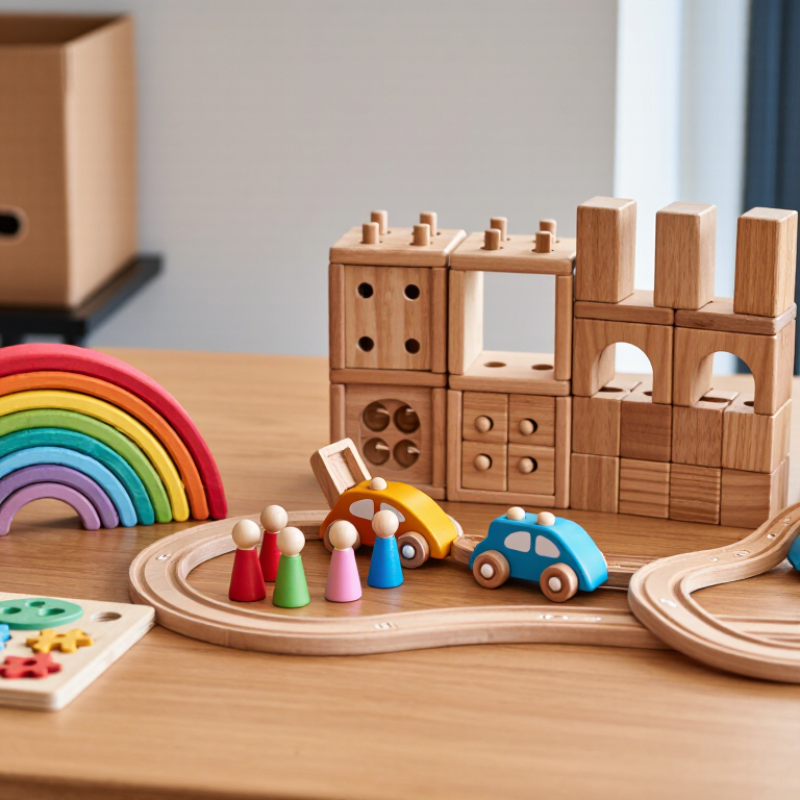
How to Find the Latest Trends in Wooden Toys?
Define the trend scope before studying colors, shapes, or finishes. Circana’s 2024 U.S. toy data reported a 6% decline in total toy dollar sales. Its pricing tables also separate unit movement from average selling price, which prevents a common mistake: confusing higher prices with stronger demand. Wooden toys should be compared within age groups, price bands, and play categories. A wooden puzzle priced near the market average may attract value-focused families, while a premium activity set needs stronger durability and learning evidence.
Look for signals, not isolated product photos. The 2024 Toy Association trend research highlighted open-ended play, developmental value, and mindful purchasing. These themes support simple wooden formats, such as stacking pieces, sorting trays, and role-play tools with visible textures. I would track quarterly sales changes, average price, review language, and retailer stock levels. Small details matter. Are parents praising longevity? Are children using the toy repeatedly? My first reading was too optimistic. Natural materials do not automatically create demand. Some designs look beautiful but offer limited play value. Circana’s data can define the commercial space, while hands-on testing checks whether the trend works beyond the spreadsheet.
Define the trend scope with 2024 U.S. toy sales and pricing data
In 2024, overall toy dollar sales decreased by approximately 1%, while unit sales increased by approximately 1% and average selling prices declined by approximately 2%. For wooden toy development, this points to steady demand, stronger value sensitivity, and an opportunity to create durable products with clear educational or play benefits.
Market-level indicators for the U.S. toy category; percentage changes are rounded and use 2023 as the comparison year.
How to Find the Latest Trends in Wooden Toys?
Statista’s age and category metrics offer a practical way to segment wooden-toy demand. Start with age groups, such as infants, preschool children, and early learners. Then compare categories, including building sets, role-play toys, puzzles, and pull-along products. This structure reveals more than broad sales growth. It shows who buys, what they seek, and when interest changes.
Age matters greatly. Parents of toddlers often value rounded edges, quiet play, and simple shapes. Families with preschool children may prefer counting boards, stacking pieces, and pretend kitchens. Statista’s Consumer Market Insights can help compare these needs across age-related categories and regions. The 2023 global toy market reached about 108.7 billion dollars, according to Circana’s industry reporting, despite a year-on-year decline. That pressure makes narrow segmentation useful. Grand View Research also reports continued growth in the wooden-toy market, supported by demand for durable and educational products.
Look closely at category signals.
A puzzle may serve both learning and gifting purposes. A wooden vehicle may attract younger children, but its sales can depend on seasonal browsing. I would not treat every “educational” claim as reliable. Some products sound developmental without strong evidence. Compare search interest, retail pricing, age labels, and review language. The data can guide decisions, but it cannot replace observing how a child actually handles the toy.
| Age Segment | Typical Developmental Stage | Relevant Wooden-Toy Categories | Core Demand Need | Demand Metric to Track | Trend Indicators | Safety and Product Requirements |
|---|---|---|---|---|---|---|
| 0–2 years | Sensory exploration, grasping, cause-and-effect learning | Large-piece grasping toys, stacking toys, simple rolling toys, activity boards | Safe tactile interaction and basic motor development | Unit demand by age group; repeat purchase rate; search interest for infant wooden toys | Natural finishes, rounded forms, quiet play, easy cleaning, sustainable materials | Avoid detachable small parts; products intended for children under 3 must meet applicable small-parts requirements |
| 3–5 years | Symbolic play, early problem-solving, language development | Pretend-play sets, wooden puzzles, shape sorters, counting toys, construction sets | Imaginative play combined with early learning | Category share; average selling price; conversion rate; educational-toy search volume | Open-ended play, Montessori-inspired formats, basic numeracy, gender-neutral design | Check construction strength, paint safety, accessible edges, and age labeling |
| 6–8 years | Rule-based play, creativity, planning, and independent learning | Advanced building sets, strategy games, craft kits, science-themed wooden toys, puzzles | Challenge, mastery, creativity, and social interaction | Revenue by category; sales velocity; review volume; repeat interest in construction toys | Modular systems, problem-solving, screen-free activities, collaborative play | Small parts may be appropriate only when the product is clearly labeled for the correct age group |
| 9–12 years | Complex reasoning, hobbies, collecting, and project-based learning | Mechanical models, architectural sets, advanced puzzles, tabletop games, skill-based kits | Longer engagement, technical skills, and personal interests | Value share; product engagement time; price tolerance; category growth over time | Engineering concepts, customizable designs, collectible formats, premium craftsmanship | Provide clear assembly guidance and verify structural stability and material safety |
| Parents and gift buyers | Purchase decision influenced by usefulness, durability, and perceived value | Multi-age toys, educational sets, heirloom-style products, gift bundles | Durability, educational value, reduced plastic use, and gift suitability | Purchase frequency; basket value; gift-season demand; sustainability-related search terms | Plastic reduction, responsibly sourced wood, repairability, minimalist packaging | Use transparent age guidance, material information, care instructions, and applicable conformity markings |
Finding current trends in wooden toys requires more than watching popular colors or copying social media posts. I begin with Google Trends, comparing terms such as “FSC wooden toys,” “wooden stacking toys,” and “eco-friendly play sets.” The tool shows relative search interest, not actual sales. That distinction matters. A sudden spike may reflect a holiday, news story, or temporary parenting trend.
FSC certification adds a stronger sustainability signal. Check whether a toy’s packaging shows a valid certificate code, then verify it through the official certification database. A credible supply chain should connect the certified forest, manufacturer, and seller. Look closely at the wording. “Made with wood” does not prove responsible sourcing. I also examine paint safety information, product age guidance, and manufacturing details before treating an item as genuinely eco-designed.
Search data becomes more useful when paired with physical observation. At trade events or small retailers, I note unfinished surfaces, rounded edges, repairable parts, and compact packaging. These details reveal design priorities that keyword charts cannot show. My method is not perfect. Google Trends can favor English-speaking searches, while certification records may lag behind production changes. I sometimes overread a short-term increase. Rechecking the same terms by country, month, and product category helps reduce that mistake and gives a more defensible view of where wooden toy design is moving.
How to Find the Latest Trends in Wooden Toys?
New wooden-toy trends now combine tactile play with measurable safety improvements. A smooth beech puzzle may use water-based paint, rounded edges, and hidden fasteners. However, appearance proves little. EN 71-1 examines mechanical and physical risks, including small parts, sharp points, and accessibility. EN 71-2 addresses flammability, while EN 71-3 tests the migration of certain elements from materials and coatings. ASTM F963 covers comparable hazards for the United States, but its test methods and limits are not identical. A toy passing one framework may still need separate evaluation for another market.
The European Commission’s 2023 Safety Gate report recorded 3,412 product alerts across categories. Toy-related chemical and choking risks remain recurring concerns. The U.S. Consumer Product Safety Commission reported 231,067 toy-related emergency-room injuries in 2023. These figures make “innovative” design a testing question, not a marketing phrase. Look for documented testing of paint layers, joints, magnets, cords, and breakage resistance. Traceable batch records also help investigators identify problems quickly. Some new designs still add unnecessary parts. That weakens the safety story.
Tips: Compare the exact standard edition and test scope. Ask whether testing covered the finished toy, not only raw wood. Inspect corners under bright light. Rub painted surfaces with a clean cloth. Recheck labels after washing or repeated handling. I would also question vague claims like “non-toxic”; they need defined limits, laboratory methods, and supporting reports.
How to Find the Latest Trends in Wooden Toys?
A promising wooden toy concept needs more than attractive colors and smooth edges. I validate it against Euromonitor’s 2023–2028 market forecasts before investing in prototypes. The forecasts help reveal where demand may grow, including educational play, sustainable materials, and screen-free family activities. They do not guarantee sales. That distinction matters.
I start by matching each concept with measurable market signals. A wooden counting board, for example, may support early learning and home-based play. I compare its target age, price range, material story, and expected use frequency with forecasted category trends. I also review regional differences, because parents in one market may prioritize durability while others emphasize compact storage. Small details can change the opportunity.
Then I test the concept with parents, educators, and independent retailers. Their feedback can challenge the forecast. A toy may fit a growing category but feel too repetitive in real homes. I record comments about grip, noise, cleaning, packaging, and play duration. Safety documentation and responsible material sourcing must support the product claims. My process is not perfect; forecasts can miss sudden cultural shifts, and interview samples can be narrow. Still, combining expert research with direct observation creates a more reliable decision than following social media excitement alone. Test the idea twice.
Colors, shapes, and finishes can attract attention, but they do not prove demand. Compare sales by age group, price range, and play category. Looks can mislead.
U.S. toy dollar sales declined by 6% in 2024. Separate unit sales from average prices before judging demand. Higher prices may hide weaker purchasing.
Compare it with similar toys in the same age group and play category. A mid-priced puzzle may suit value-focused families. Premium activity sets need clear durability and learning benefits.
Open-ended formats remain useful, including stacking pieces, sorting trays, and role-play tools. Visible textures can invite hands-on exploration. Simple does not mean empty.
No. Search tools show relative interest, not actual sales. A short spike may come from holidays, news, or a temporary parenting trend. Treat it as a clue.
Check certification details, product age guidance, paint safety information, and manufacturing disclosures. “Made with wood” alone proves little. Packaging wording deserves scrutiny.
Look for rounded edges, unfinished surfaces, repairable parts, and compact packaging. These details reveal practical design choices. Charts cannot show everything.
Monitor quarterly sales changes, average prices, review language, and retailer stock levels. Parents may mention longevity, while children may repeat certain play patterns. My judgment can still be wrong. Recheck results by country, month, and category.
To understand what are the latest trends in wooden toys, begin by defining the market through recent sales, pricing, and volume data. Segment demand by children’s age groups, toy categories, and purchasing patterns to identify which products are gaining attention. Eco-friendly design is another important indicator: track interest in responsibly sourced materials, recyclable packaging, durable construction, and certified wood, while using search trends to measure growing consumer curiosity.
Trend research should also examine how safety innovation influences product development. Compare new concepts with recognized international toy-safety requirements, including limits on materials, small parts, durability, and mechanical hazards. Finally, test whether an idea has long-term potential by comparing it with broader market forecasts through 2028. Combining commercial data, consumer behavior, sustainability signals, safety expectations, and future projections can help creators distinguish short-lived popularity from meaningful growth opportunities in the wooden-toy market.

Joodle Toy