How to ensure wooden toys meet international safety standards begins with a practical question: where could a child be harmed? A smooth wooden pull toy may still contain loose wheels, sharp corners, unsafe paint, or detachable parts. Compliance requires more than attractive design. It demands documented testing, traceable materials, and careful production controls.
Joan Lawrence, Senior Vice President of Standards and Regulatory Affairs at The Toy Association, has stated, “Toy safety is a shared responsibility.” Her point matters because manufacturers, suppliers, laboratories, and retailers each influence the final product. Teams should review relevant requirements, including ISO 8124, EN 71, ASTM F963, and applicable national regulations. These standards can address mechanical hazards, flammability, heavy metals, chemical migration, labeling, and age grading. Requirements differ between markets. One certificate cannot automatically prove worldwide compliance.
The process should start with certified timber and supplier declarations. Then, inspect sanding quality under strong light. A child’s finger should not meet a splinter, rough edge, or poorly sealed hole. Test coatings for restricted substances, and verify that small components resist pull forces. Keep batch records, laboratory reports, corrective actions, and packaging samples. These details make compliance evidence credible.
There is no perfect checklist. A supplier may change varnish without obvious warning. A factory may pass one sample while another contains a defect. Regular audits and independent laboratory testing reduce this risk. The real goal is not merely passing a test. It is building a repeatable safety system that protects children before the toy reaches their hands.
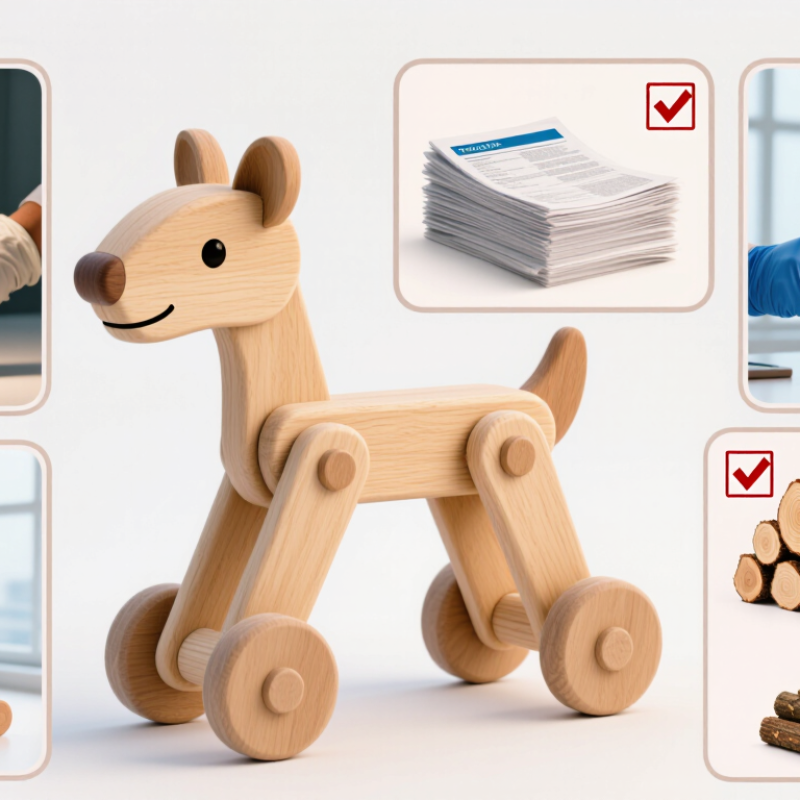
How to Ensure Wooden Toys Meet Global Safety Standards?
Define the safety requirements for each target market before designing the toy. Requirements can differ by age group, materials, labeling, and testing procedures. A wooden puzzle for toddlers may need stricter limits on small parts, sharp edges, and accessible coatings. A toy intended for older children may face different mechanical and chemical expectations. Create a market-specific checklist covering dimensions, paint composition, durability, packaging, warnings, and traceability. Do not rely on one test report for every destination. Local rules may change.
Tips: Ask an independent laboratory to review the design early. Test unfinished wood, paint, glue, and printed surfaces separately. Keep supplier declarations, batch records, and test results in one controlled file. A clear production record can make an inspection less stressful. Labels should match the target market’s language and required information. Check readability on the actual package, not only on a computer screen.
Safety also depends on real use. Drop samples onto a hard surface, pull wheels and handles, and inspect splinters after repeated handling. Watch children interact with prototypes under appropriate supervision. Their actions may reveal risks that a design review misses. A checklist is useful, but it is not perfect. Overlooking a small gap or loose coating remains possible. Review findings with qualified safety specialists and update controls when materials, suppliers, or production locations change.
| Target Market | Main Toy Safety Framework | Typical Product Scope | Key Requirements for Wooden Toys | Common Verification and Testing | Market-Access Documentation |
|---|---|---|---|---|---|
| European Union | Toy Safety Directive 2009/48/EC EN 71 series |
Toys intended for children under 14 years of age, including educational and activity toys. | Mechanical and physical safety; flammability; migration of certain elements; suitability of materials; warnings and age grading; chemical restrictions under applicable EU legislation. | EN 71-1 mechanical and physical properties; EN 71-2 flammability; EN 71-3 migration of certain elements; additional parts where relevant, such as finger paints, activity toys, or electrical functions. | Technical documentation, risk assessment, Declaration of Conformity, traceability information, required warnings, and CE marking. |
| United Kingdom | Toys (Safety) Regulations 2011 Designated UK toy safety standards |
Toys supplied in Great Britain for children under 14 years of age. | Mechanical and physical hazards; flammability; chemical migration; construction quality; instructions and warnings; product traceability. | Testing based on applicable designated versions of EN 71 and other relevant standards; review of small parts, accessible edges, points, cords, magnets, and surface coatings. | Technical file, conformity assessment records, Declaration of Conformity, importer and manufacturer details, warnings, and the appropriate conformity marking for the sales route. |
| United States | Consumer Product Safety Improvement Act (CPSIA) 16 CFR Part 1250 ASTM F963 |
Children's toys and articles primarily designed or intended for children 12 years of age or younger. | Mechanical and physical safety; lead limits; phthalate restrictions where applicable; tracking labels; accessible small parts; coatings, magnets, wood splinters, cords, and sharp points. | ASTM F963 testing; lead content and lead in surface coatings; phthalates for applicable plasticized components; small-parts and mechanical-hazard testing. | Third-party testing by an accepted laboratory, Children's Product Certificate, tracking label, permanent product identification, and applicable warnings. |
| Canada | Canada Consumer Product Safety Act Toys Regulations, SOR/2011-17 |
Toys designed, manufactured, or marketed for children under 14 years of age. | Protection against choking, ingestion, entrapment, sharp points, sharp edges, toxic substances, excessive noise, flammability, and unsafe surface coatings. | Mechanical and physical safety assessment; small-parts testing; coating and substrate chemical analysis; flammability and sound-level checks where applicable. | Test records, supplier and production traceability, product instructions, hazard warnings, and documentation demonstrating compliance with Canadian requirements. |
| Australia | Australian Consumer Law Mandatory toy safety requirements for applicable age groups AS/NZS ISO 8124 series |
Toys intended for children, with additional mandatory requirements applying to toys for children up to and including 36 months. | Structural integrity; small parts; accessible points and edges; cords and elastic elements; toxic materials; packaging hazards; age suitability and warnings. | Relevant AS/NZS ISO 8124 testing; small-parts cylinder assessment; tests for accessible sharp points and edges, tension, torque, drop, and impact where applicable. | Supplier evidence, test reports, product and packaging warnings, traceability records, and documentation showing conformity with the applicable mandatory standard. |
| New Zealand | Product Safety Standards ISO 8124-based toy safety requirements where applicable |
Toys supplied for children, with particular attention to toys intended for children under 36 months. | Choking and ingestion hazards; sharp points and edges; structural strength; flammability; hazardous substances; instructions and age warnings. | Applicable ISO 8124 or recognized equivalent testing, including mechanical and physical safety, small parts, and chemical-risk evaluation. | Test reports, supplier compliance records, product identification, instructions, and warnings appropriate to the intended age group. |
| China | GB 6675 series National Toy Safety Standards |
Toys designed or clearly intended for children under 14 years of age. | General safety requirements; mechanical and physical properties; flammability; migration of specific elements; labeling, instructions, and warnings. | GB 6675 testing for physical and mechanical hazards, flammability, and migration of elements; additional tests according to the toy category. | Chinese-language product information where required, safety labels, instructions, warnings, inspection records, and applicable conformity documentation. |
| Japan | Consumer Product Safety Act Applicable toy safety requirements and voluntary industry standards |
Toys marketed for infants and children, with stricter attention to products intended for young children. | Choking prevention; sharp-point and sharp-edge control; durability; material safety; paint and coating safety; age guidance and warning information. | Mechanical and physical safety assessment; small-parts evaluation; chemical analysis of coatings and materials; durability and labeling review. | Japanese-language instructions and warnings, product traceability, test reports, and documentation supporting compliance with applicable Japanese requirements. |
| South Korea | Special Act on the Safety of Children's Products Safety standards for children's products |
Children's products and toys intended for children, subject to the applicable product classification. | Physical and mechanical safety; hazardous substances; coatings; small parts; flammability; labeling and age classification. | Product safety testing through the applicable Korean conformity route, including physical, chemical, and labeling evaluations. | Required safety certification or supplier conformity documentation, Korean-language labeling, warnings, importer information, and traceability records. |
| Gulf Cooperation Council Markets | GSO technical requirements for toys National implementation requirements may also apply |
Toys intended for children under 14 years of age and supplied in participating Gulf markets. | Mechanical and physical safety; flammability; migration of elements; chemical restrictions; Arabic and English safety information where required. | Testing against the applicable GSO toy safety requirements, commonly covering physical hazards, flammability, chemical migration, and labeling. | Technical file, conformity documentation, test reports, importer details, bilingual warnings and instructions, and any required product registration. |
Choose solid, untreated hardwood from traceable suppliers. Avoid cracks, mold, stains, and strong odors. Appearance proves little. Keep supplier records and material origins.
No. Water-based paint still requires chemical testing. Check heavy metals, chemical migration, and restricted substances. Let painted surfaces cure fully before assembly.
Rub each surface with a clean white cloth. Stop if color transfers. Test again after abrasion. Uncertain results need qualified laboratory review.
Avoid sharp screws, brittle plastic, long cords, and accessible small magnets. Use rounded edges and large, one-piece parts. Children pull harder than expected.
Test wheels, hinges, knobs, eyes, and handles by hand. Use pull and torque tests where appropriate. One loose washer can defeat good material choices.
Test every toy against requirements for its market, design, and age group. Examine small parts, sharp edges, coatings, flammability, and chemical migration. Test production samples, not only polished prototypes.
Keep material lists, coating details, supplier declarations, test reports, age grading, warnings, and corrective actions. Record product versions, batch numbers, test dates, and laboratory details.
Inspect incoming wood for cracks, moisture differences, and contamination. Check sanding under angled light. Photograph defects and record measurements. Independent audits help, but daily discipline still matters.
No checklist catches every weakness. Children misuse toys in unpredictable ways. A sampling plan may miss rare defects. Review failures honestly and repeat testing after design or material changes.
Ensuring wooden toys are safe for children begins with clearly identifying the safety requirements of each target market. Manufacturers should choose responsibly sourced wood, non-toxic paints and finishes, secure fasteners, and child-friendly components that can withstand regular use. The design should also reduce common hazards by avoiding sharp edges, small detachable parts, pinch points, and weak structures that may break during play.
A reliable process for how to ensure wooden toys meet international safety standards includes testing products against the regulations and performance requirements that apply in intended markets. Safety evaluations may cover mechanical strength, flammability, chemical content, coating durability, and age-related risks. Manufacturers should keep accurate records of material sources, design reviews, test results, and corrective actions. Ongoing quality control, including supplier checks, production inspections, and periodic retesting, helps ensure that every batch continues to meet established safety expectations.

 Joodle Toy